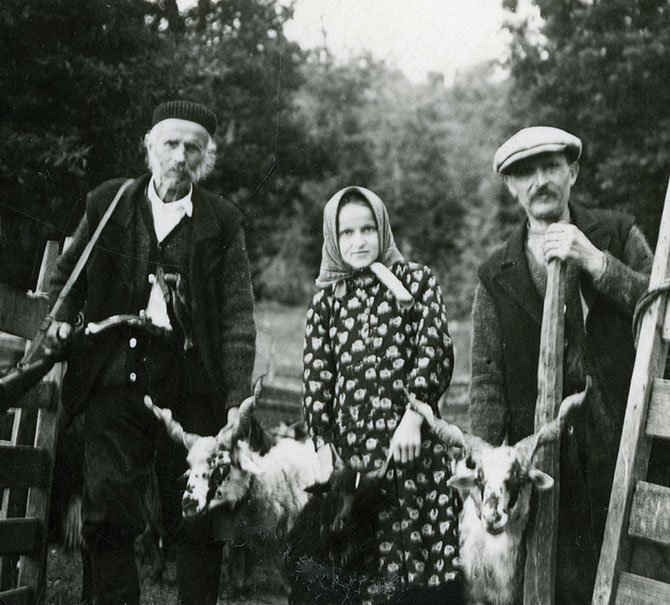
Everyday life at the mountain huts of Podgorje is not fully documented by written sources. What we know comes from rare travel accounts, ethnological research and oral history. The picture of a shepherd’s day is therefore partially a reconstruction — based on available testimonies, but also on analogies with similar pastoral communities.

Morning on the mountain

The mountain awakens early. Before sunrise, while the grass is still wet with dew and fog lies in the valleys, the first task would begin: milking the sheep and goats. The sounds of animals, the cold air, sometimes the bura wind blowing from the sea — this was the morning reality of a mountain hut.

Food, water and firewood had to be managed. Everything came from nature or was carried on one's back — there were no shops, no shortcuts. The mountain provided grass, water and shelter. Everything else had to be earned, preserved or brought from afar.

Day with the herd

Most of the day was spent outdoors with the herd. Men and women alike stayed on the mountain — and according to the oral histories of local inhabitants, both women and young girls tended the herd.

Grazing was not random — it was based on a deep knowledge of the terrain, grass and water, and movement followed a circular pattern so that the pastures could regenerate.

Evening by the hearth

As the sun went down, the herd returned to the pens, enclosed spaces built using the dry-stone technique. Simple food was prepared over the open hearth — bread baked under the peka bell, beans, whatever was on hand. With few utensils and modest ingredients, dinner was as simple as everything else on the mountain.

The hearth was the centre of life. In its light, meals were shared, the day was recounted and stories were passed down. In the rhythm of the fire, silence and conversation, the mountain grew still.

Night in the silence of the mountain

Night did not bring complete rest. The herd had to be guarded — the wolves were always on the prowl. The Podgorje dogs were not large, because a big dog requires an abundant diet that the Podgorje people could not provide. They defended themselves differently: shouting, yelling, and blowing trubljike — giant pipes made of linden wood whose piercing sound echoed through the mountain at night, driving predators away from the pens.