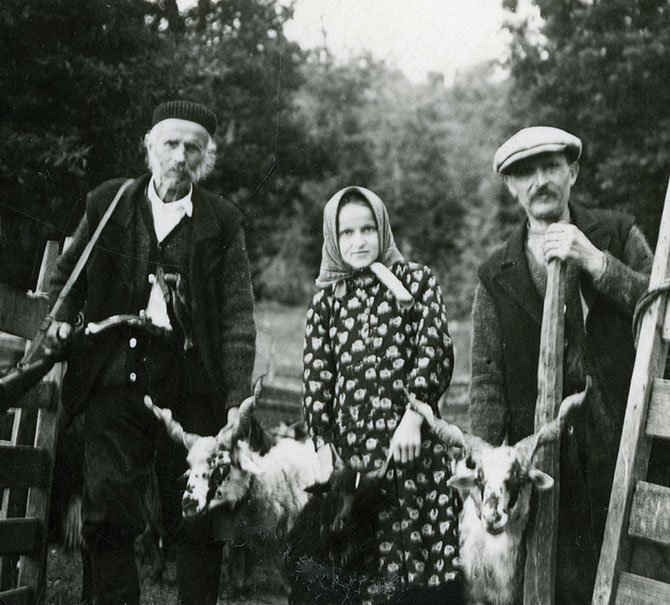
The mountain that fed many

On southern Velebit, pastoral traditions from all directions intersected — from the maritime coast, from Lika, Ravni Kotari and Bukovica.

From the coast came the Primorci and Podgorci. They reached the summer huts in the uplands gradually, resting their herds at stopping points along the podgorje — the rocky slope that was both home and path. They would remain on the mountain for three to five months. The household was managed by the woman, the land was cultivated, and life was simultaneously anchored to both the sea and the mountain.

Shepherding families from Lika, Ravni Kotari and Bukovica also came to these same pastures, each with their own needs. The people of Lika were primarily farmers — they drove their livestock up the mountain to protect their crops while they ripened. The people of Bukovica, on the other hand, lived exclusively from livestock farming, without arable land. They were led by a strugovođa, a male leader of the herd and of the entire travelling community, who decided on the route, pace and organization of the whole journey.

Velebit at the crossroads of two European pastoral traditions

Two European pastoral models, which developed independently of one another, met on Velebit.

Vitomir Belaj links the gradual migration of the Primorci and Podgorci, with the central role of the woman at the mountain hut, to the traditions of the Liburnian tribe that inhabited this area and with whom matriarchy is associated. According to Tomo Vinšćak, this model shares parallels with the Alpine tradition of seasonal huts.

The seasonal movements of shepherding families from the interior (Lika, Bukovica, Ravni Kotari) — along long routes between summer and winter pastures — belong to transhumant livestock farming, an ancient Balkan tradition also known in the Pyrenees, Apennines, Carpathians, Caucasus and Scotland, where it has survived in places to this day.

The end of a way of life

From the 1980s up until the beginning of the Croatian War of Independence in 1991, around twenty families from the Podgorje villages — Lukovo Šugarje, Kruščica, Poljci, Šibuljina, Seline, Jesenice and others — still moved up to the summer huts of southern Velebit. Four families came from Bukovica: the Jurjević, Brevulj and Vukić families from Kruševo, and the Ležaja family from the village of Ležaje near Zelengrad.

Today, this way of life has almost completely vanished. What remains are pastures overgrown by nature, huts whose stones are slowly returning to the mountain, and paths trodden by hikers and curious travellers.